
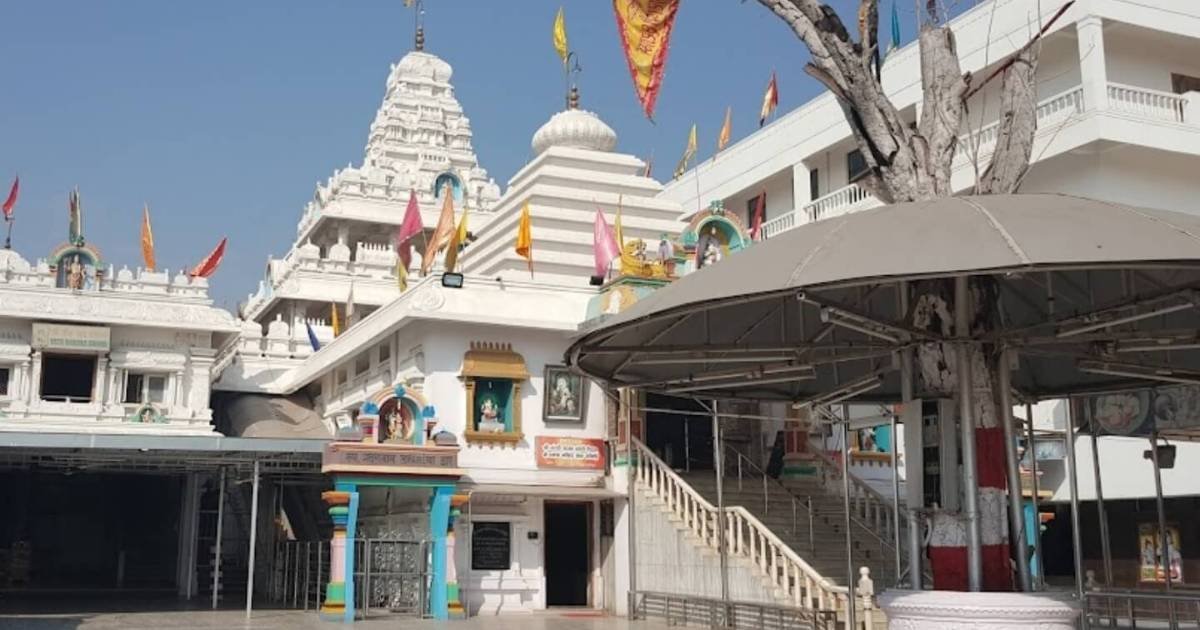
Tucked on a small hillock in the heart of Kachiguda, right across from the busy Kachiguda Railway Station, Shyam Mandir stands as one of Hyderabad’s most visited spiritual landmarks. This temple complex is dedicated to Khatu Shyam Baba, a form of Lord Krishna that carries deep devotional significance across North India and has now found a permanent home in South India as well. Every day, hundreds of devotees climb the temple steps to seek blessings, listen to bhajans, and witness the aarti that fills the air with a sense of calm.
If you’re planning a visit in 2026, whether for daily darshan, a festival, or simply to understand what makes this temple special, this guide covers everything: its history, mythology, architecture, sub temples, daily rituals, festival calendar, timings, and travel directions.
Historical Background of Shyam Mandir Kachiguda Hyderabad
The site where Shyam Mandir now stands was originally known as Veeranna Gutta, a modest hillock that once housed a small shrine dedicated to Lord Hanuman. Over time, a Shiva temple was also added to the hill, and the location gradually became a quiet spot of local worship long before it took its present form.
The transformation into a full-fledged Khatu Shyam temple began around 1992, when a group of devotees came together to form the Shree Shyam Mandir Seva Samithi. Their goal was simple yet ambitious: to bring the spiritual essence of Rajasthan’s famous Khatu Shyam Temple to the devotees of Telangana who could not travel all the way to Khatu village every year.
After years of planning and construction, the temple was formally inaugurated on 22 April 1996 by Sri Jayendra Saraswathi Swami and Sri Ananth Saraswathi Swami, the respected Shankaracharyas of the Kanchi Kamakoti Peetham. Since that day, the temple has grown steadily in both scale and popularity, evolving from a single shrine into a multi-deity complex that now attracts devotees from across Hyderabad, Secunderabad, and neighboring states.
Mythological Significance of Shyam Baba
Shyam Baba is not a separate deity from Krishna but one of his most compassionate forms, associated with the legendary warrior Barbarika from the Mahabharata. Understanding his story helps devotees connect more deeply with the darshan experience.
The Story of Barbarika
Barbarika was the son of Ghatotkacha and grandson of Bhima, one of the five Pandava brothers. Even as a young warrior, he possessed extraordinary skill in archery, taught to him by his mother. Pleased by his devotion, the gods gifted him three infallible arrows, earning him the title Teen Baan Dhari, or “bearer of three arrows,” along with a bow from Agni that made him nearly invincible.
Before the great Mahabharata war, Barbarika made a vow to always fight on the side that was losing. Knowing that this single decision could change the entire outcome of the battle, Lord Krishna, disguised as a Brahmin, tested the young warrior’s power. He challenged Barbarika to tie every leaf of a peepal tree using just one arrow. Barbarika accepted, closed his eyes, and released the arrow, which began circling every leaf, including one that Krishna had secretly hidden under his own foot.
Realizing the boy’s true strength and the danger it posed to the balance of the war, Krishna asked Barbarika for his head as an offering, a gift the warrior gave without hesitation, since he considered Krishna his guru. Before the sacrifice, Barbarika requested one final wish: to witness the entire war. Krishna placed his head atop a hill overlooking the battlefield, from where Barbarika watched every moment of the Mahabharata unfold.
Read More: Sri Ganesh Temple Secunderabad: Timings, Poojas, History & How to Reach
The Discovery of Khatu Shyam
According to popular belief, Barbarika’s head was later found buried in Khatu village in Rajasthan’s Sikar district. The spot remained hidden until a cow, while grazing nearby, began spontaneously releasing milk over the ground. Curious villagers dug at the site and unearthed the sacred head. Roop Singh Chauhan, the local ruler at the time, had a dream instructing him to build a shrine and install the relic within it. This led to the construction of the original Khatu Shyam Temple.
Pleased with Barbarika’s selfless sacrifice, Krishna had already blessed him with a boon: that in the Kaliyuga, he would be worshipped under the name Shyam, one of Krishna’s own names, and that devotees who sought him with a true heart would never leave empty handed. This is why he is also affectionately called Hare Ka Sahara, meaning the support of those who have already lost hope.
Architecture of Shyam Mandir Complex
The temple’s architectural blueprint was prepared by Padma Bhushan Sri Ganapathi Sthapathi, one of the most respected temple architects in India, known for designing several iconic South Indian temples. His involvement gives the structure both aesthetic beauty and traditional accuracy in temple design principles.
Spread across roughly 30,000 square feet, the temple complex rises across three floors and sits on a raised platform that offers a commanding view of the surrounding Kachiguda locality. The design blends South Indian Dravidian temple elements, including a decorated gopuram, with functional community spaces that make it far more than just a place of worship.
Key Architectural Features
- A multi-tiered gopuram entrance adorned with intricate carvings and traditional motifs
- A spacious mandapam used for bhajans, satsangs, and community gatherings
- An auditorium hall for larger religious events and discourses
- A dedicated kitchen and food court that serves prasadam and meals to visitors
- Wide, well-lit corridors connecting the main shrine to the various sub temples
- A raised hillock base that keeps the sanctum elevated above street level, adding to its visual grandeur
Main Deity – Shyam Baba
The presiding deity of the temple is Shyam Baba, worshipped in his divine form as an incarnation of Krishna. The idol is dressed daily in a fresh Poshak, a traditional outfit whose color and style change according to the day of the week, ongoing festivals, and special occasions throughout the year.
On significant days, the idol is further adorned with gold ornaments, silver accessories, and elaborate flower decorations, transforming the sanctum into a vision of color and devotion. Devotees believe that a sincere prayer at this shrine, especially one made with humility and patience, is rarely left unanswered, which is part of why the temple sees a steady stream of visitors throughout the year, not just during major festivals.
Sub Temples Inside Shyam Mandir Complex
What sets Shyam Mandir apart from many single-deity temples is its complex of sub shrines, each dedicated to a different deity. This makes it possible for a single visit to cover blessings from multiple gods and goddesses.
1. Radha Krishna Temple
This shrine celebrates the eternal bond between Radha and Krishna, and is especially popular during Janmashtami, when devotees gather to sing bhajans dedicated to their divine love.
2. Lakshmi Narayana Temple
Dedicated to Lord Vishnu and Goddess Lakshmi, this shrine is often visited by devotees seeking prosperity, financial stability, and household harmony.
3. Lord Anjaneya Shrine
Honoring Lord Hanuman, this shrine is a reminder of the site’s original identity as a Hanuman temple before Shyam Baba became the presiding deity. Saturdays see a noticeably higher footfall here.
4. Kaal Bhairava Shrine
Kaal Bhairava, a fierce protective form of Lord Shiva, is worshipped here by devotees looking for protection from negative energy, fear, and unresolved obstacles in life.
5. Shiva Temple
One of the oldest shrines within the complex, predating the main Shyam Baba temple, this Shiva shrine continues to draw devotees for daily abhishekam and Monday prayers.
6. Amba Mata and Naag Devta Shrines
These shrines honor the Mother Goddess and the serpent deity respectively, and are commonly visited by devotees performing rituals related to family well-being, fertility, and ancestral peace.
Read More: Kesari Hanuman Temple Hyderabad: History, Timings & Guide
Daily Rituals and Spiritual Activities
The temple follows a structured daily schedule of prayers, aarti, and offerings that devotees can plan their visit around.
Morning Session
The day begins early with the opening of the sanctum, followed by Mangala Aarti and Abhishekam. The idol is bathed, dressed in a fresh Poshak, and decorated before the doors open for public darshan.
Evening Session
The evening session includes Sandhya Aarti, accompanied by devotional bhajans and kirtans that continue for close to an hour. This is often considered the most spiritually charged time to visit, as the temple fills with lamps, incense, and the collective chanting of devotees.
Special Weekly Observances
- Saturdays are dedicated to Lord Hanuman, with special prayers at the Anjaneya shrine
- Mondays see extra footfall at the Shiva temple for abhishekam
- Ekadashi days across the month are treated as especially auspicious for Shyam Baba darshan, drawing significantly larger crowds than a regular weekday
Festivals Celebrated
Festivals at Shyam Mandir are marked by elaborate decorations, extended darshan hours, and a noticeably festive atmosphere that spills out beyond the temple gates.
Janmashtami
Celebrating the birth of Lord Krishna, Janmashtami at Shyam Mandir includes midnight aarti, devotional singing, and a beautifully decorated sanctum that draws some of the largest crowds of the year.
Falgun Mela (Khatu Shyam Mela)
Modeled after the massive Falgun Mela held at the original Khatu Shyam Temple in Rajasthan, this local celebration usually falls between February and March and includes special poojas, cultural programs, and a surge in devotee footfall over several days.
Ekadashi Celebrations
Both Falgun Ekadashi and Kartik Ekadashi hold particular importance for Khatu Shyam devotees, since these dates are closely tied to Barbarika’s own birth and legacy. Special aarti and bhog are arranged on these days.
Other Festivals Observed
- Holi, marked with color and devotional fervor
- Diwali, with the entire complex lit up in diyas and lights
- Navratri, observed with special prayers at the Amba Mata shrine
- Maha Shivratri, celebrated at the temple’s Shiva shrine with night-long prayers
Spiritual Experience at the Temple
What draws devotees back to Shyam Mandir again and again isn’t just the architecture or the festivals, it’s the atmosphere. The sound of bhajans drifting across the hillock, the smell of fresh flowers and incense, and the quiet discipline of hundreds of people waiting patiently for darshan create an experience that feels both grounding and uplifting.
Many first-time visitors describe a sense of peace that settles in almost immediately after climbing the temple steps, a feeling regular devotees attribute to Shyam Baba’s reputation as a deity who listens closely to those who feel forgotten or hopeless. Whether you come with a specific wish or simply to observe the rituals, the experience tends to leave a lasting impression.
Shyam Mandir Kachiguda Timings
| Session | Timing |
| Morning Darshan | 6:00 AM to 12:00 PM |
| Evening Darshan | 5:00 PM to 10:00 PM |
These timings apply on regular days throughout the week. During major festivals such as Janmashtami or the Falgun Mela, the temple often extends its hours to accommodate larger crowds, so it’s a good idea to check with the temple office a day in advance if you’re planning a festival visit. Early morning and late evening slots tend to be the least crowded, making them ideal for a peaceful, unhurried darshan.
Read More: Cheruvugattu Shiva Temple Near Hyderabad: A Complete Guide
How to Reach Shyam Mandir
Getting to Shyam Mandir is straightforward, thanks to its central location in Hyderabad.
By Train
Kachiguda Railway Station is barely half a kilometer from the temple, making it the most convenient option for visitors arriving from outside the city. Dabirpura Railway Station is another nearby alternative.
By Road (Bus)
Numerous TSRTC city buses connect Kachiguda to every major part of Hyderabad and Secunderabad. The Mahatma Gandhi Bus Station, roughly 2.7 km away, also serves as a convenient starting point for those coming by long-distance bus.
By Metro
The nearest metro stations are Chikkadpally and Narayanguda, both within a short walk or a quick auto ride from the temple, making the metro one of the fastest ways to beat Hyderabad’s traffic.
By Air
Rajiv Gandhi International Airport, Shamshabad, is around 26 to 29 km from the temple. Prepaid taxis and cab services are readily available for the roughly 45 minute drive.
By Personal Vehicle
For those driving, the temple is well connected via Hyderabad’s main road network, and parking is available in the surrounding Kachiguda and Barkatpura streets, though it can get tight during festival days.
Why You Should Visit Shyam Mandir Kachiguda?
- It offers direct access to Khatu Shyam Baba’s blessings without needing to travel all the way to Rajasthan
- The multi-deity complex lets you seek blessings from Krishna, Hanuman, Shiva, Lakshmi Narayana, Kaal Bhairava, and more, all in a single visit
- Its central location near Kachiguda Railway Station makes it easy to combine with other travel plans in Hyderabad
- The temple’s architecture, shaped by a renowned Sthapathi, offers genuine visual and cultural appeal
- Regular festivals and daily aarti create frequent opportunities for a meaningful spiritual experience
- It provides a calmer, less crowded alternative for devotees who cannot make the long pilgrimage to Khatu village during peak mela season
Shyam Mandir Kachiguda Contact Number
For darshan queries, festival schedules, or Poshak seva bookings, you can reach the temple office at 091601 27638. For the most current updates, including any temporary changes to timings, it’s best to check the temple’s official social media pages or its website before planning a visit, since committee contacts and schedules are occasionally updated.
FAQ’s
What are the darshan timings at Shyam Mandir Kachiguda?
The temple is open from 6:00 AM to 12:00 PM in the morning and 5:00 PM to 10:00 PM in the evening, daily.
Who is the main deity of Shyam Mandir?
The main deity is Shyam Baba, worshipped as a divine form of Lord Krishna and associated with the warrior Barbarika.
When was Shyam Mandir Kachiguda built?
The temple was inaugurated on 22 April 1996, though planning and construction by the Shree Shyam Mandir Seva Samithi began around 1992.
How far is Shyam Mandir from Kachiguda Railway Station?
It is located barely half a kilometer away, making it easily walkable from the station.
Is there an entry fee for Shyam Mandir Kachiguda?
No, entry and darshan at the temple are free for all devotees.
Which festival is celebrated most grandly at the temple?
Janmashtami and the Falgun Mela (Khatu Shyam Mela) are the two most widely celebrated festivals here.
What is the significance of Ekadashi at this temple?
Ekadashi, especially Falgun and Kartik Ekadashi, is closely linked to Barbarika’s legacy and sees larger crowds and special rituals.
Are there other deities worshipped inside the same complex?
Yes, the complex includes shrines for Radha Krishna, Lakshmi Narayana, Anjaneya, Kaal Bhairava, Shiva, Amba Mata, and Naag Devta.
Who designed the temple’s architecture?
The temple’s blueprint was designed by the renowned temple architect Sri Ganapathi Sthapathi.
What is the best time to visit for a peaceful darshan?
Early morning hours right after opening, or late evening before closing, tend to have the smallest crowds.
Conclusion
Shyam Mandir Kachiguda is far more than a single shrine dedicated to Khatu Shyam Baba. It’s a living complex of faith that brings together multiple deities, a rich mythological backstory rooted in the Mahabharata, thoughtful architecture, and a rhythm of daily rituals that has drawn devotees for nearly three decades.
Whether you’re visiting for the first time out of curiosity or returning as a regular devotee seeking Shyam Baba’s blessings, this guide should help you plan a visit that’s both spiritually fulfilling and logistically smooth in 2026. If you find yourself in Hyderabad, especially near Kachiguda, a short stop at this hillock temple is well worth the climb.