
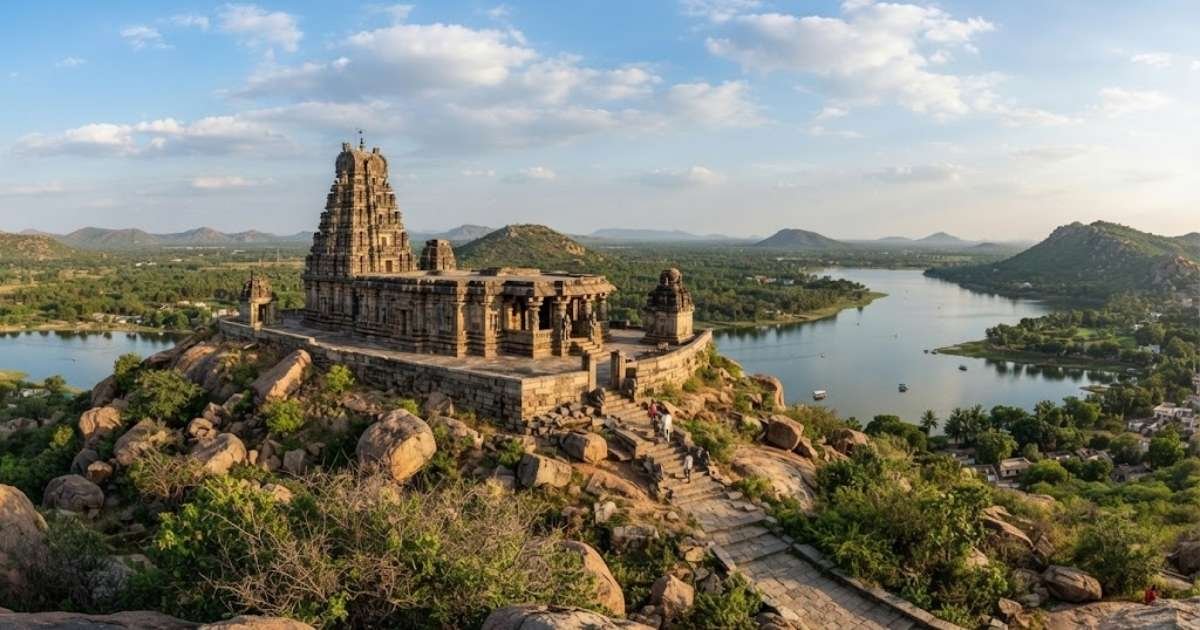
Perched on a rocky hillock in Nalgonda district, the Cheruvugattu Shiva Temple is one of Telangana’s most powerful yet underrated pilgrimage sites. Dedicated to Lord Shiva in the form of Sri Jadala Ramalingeswara Swamy, this ancient shrine draws lakhs of devotees every year during its grand Magha Masam jatara. Located roughly 80 to 87 km from Hyderabad on the Vijayawada highway, it makes for an easy one-day trip for anyone seeking a genuine, less commercial temple experience rooted in rural Telangana faith.
If you are planning a visit, here is everything you need, from the temple’s mythology and architecture to its jatara rituals, timings, distance, and travel routes.
Quick Facts About Cheruvugattu Temple
- Deity: Lord Shiva as Sri Jadala Ramalingeswara Swamy, with consort Goddess Parvathi
- Location: Cheruvugattu village, Narketpally Mandal, Nalgonda district, Telangana
- Distance from Hyderabad: approximately 80 to 87 km
- Distance from Nalgonda town: approximately 15 to 16 km
- Best known for: Magha Masam jatara and the Aggigundalu firewalking ritual
- Temple timings: 6:00 AM to 1:00 PM and 3:00 PM to 7:30 PM daily
Cheruvugattu Temple Location and Geography
Cheruvugattu is a small village in Narketpally Mandal, part of Nalgonda district in Telangana. The temple itself sits atop a granite hillock surrounded by open farmland, a landscape typical of the Telangana plateau.
The site lies close to National Highway 65, the busy Hyderabad to Vijayawada corridor. Travelers driving from Hyderabad usually take a right turn near Narketpally town and cover another 4 to 8 km of interior road to reach the base of the hill. A Parvathi temple stands just below the hillock, while the main Shiva sanctum sits higher up among natural rock formations.
Because of this elevated, rocky setting, the temple offers sweeping views of the surrounding countryside, and the climb itself is considered part of the spiritual journey by regular devotees.
Cheruvugattu Temple History
The temple’s origin is tied to the legend of Sage Parashurama, the sixth avatar of Lord Vishnu. According to local belief, after avenging the killing of his father, Sage Jamadagni, Parashurama undertook a vow to rid the earth of oppressive rulers. As part of his penance and travels, he is said to have circled the earth 21 times and installed 108 sacred Shiva shrines across different regions as places where devotees could seek atonement and blessings.
Cheruvugattu is counted among these legendary 108 shrines, which is why the Shiva lingam here is regarded as swayambhu, or self-manifested, rather than manually installed. This origin story gives the temple deep mythological weight despite its relatively modest size compared to larger Telangana shrines.
Over generations, the temple has remained a village-rooted institution, sustained largely by local devotion, farming communities, and the Telangana Endowments Department rather than royal patronage or large-scale historical inscriptions, which is common for several rural hill shrines in the region.
Presiding Deity: Sri Jadala Ramalingeswara Swamy
The presiding deity of Cheruvugattu is Lord Shiva, worshipped here as Sri Jadala Ramalingeswara Swamy, along with his consort Goddess Parvathi. Together they are often referred to as Sri Parvathi Jadala Ramalingeswara Swamy.
It is worth noting that Telangana has more than one Shiva temple associated with the name Someshwara, including the well-known Sri Someswara Temple at Kolanupaka in the neighbouring Yadadri Bhuvanagiri district. Cheruvugattu’s own deity, however, is distinctly worshipped as Ramalingeswara Swamy, and this is the name used in temple records, local tradition, and official jatara announcements.
The main lingam rests inside a narrow rock-enclosed sanctum, and devotees must pass between natural boulders to reach it, adding a raw, cave-temple atmosphere rarely found in urban shrines.
Temple Architecture
Cheruvugattu’s architecture is shaped almost entirely by its natural rock terrain rather than elaborate man-made structures. Key architectural features include:
- A garbhagriha (main sanctum) built within a narrow passage between large granite boulders
- Around 365 stone steps leading up the hill for those who choose to walk instead of drive
- Three additional sacred lingas, locally referred to as Moodu Gundlu or Muddu Gundlu, positioned around the main shrine
- One linga placed atop a high rock, reachable only by narrow iron steps, with a small entry fee charged for the climb
- A separate Parvathi shrine located at the base of the hill
This blend of rock-cut sanctum, open hill terrain, and minimal ornamentation gives Cheruvugattu the character of an ancient tapobhoomi, a place meant for penance and quiet devotion, rather than a grand Dravidian-style temple complex.
Cheruvugattu Jatara: One of Telangana’s Largest Shiva Festivals
The Cheruvugattu Jatara, also called the Brahmotsavams, is the temple’s biggest annual event and one of the more significant Shiva festivals in the Nalgonda region. It is held every year during Magha Masam, typically falling in late January or February according to the Telugu calendar, and usually runs for about seven to eight days.
During this period, the temple sees a massive surge in footfall, with reports of well over one lakh devotees visiting across the festival week. Pilgrims arrive not only from across Telangana and Andhra Pradesh, but also from Maharashtra, Karnataka, and Tamil Nadu, making it a truly regional pilgrimage event rather than a purely local one.
Highlights of the Jatara
The jatara unfolds through a sequence of traditional rituals spread across several days, each with its own religious significance for devotees and farming communities alike.
Rituals and Sevas
- Nagarotsavam, the formal opening procession that kicks off the Brahmotsavams
- Swamivari Kalyana Mahotsavam, the celestial wedding of Shiva and Parvathi, usually performed in the early morning hours
- Aggigundalu, the firewalking ritual where devotees walk barefoot across burning coals while carrying the deity’s palanquin
- Ashva Vahana Seva, a procession featuring the deity mounted on a horse vehicle
- Deepotsavam, an evening lamp-lighting ceremony across the temple premises
- Gaja Vahana Gramotsavam, the concluding elephant-vehicle procession through Cheruvugattu and neighbouring Yellareddygudem village
Read More: Komuravelli Mallanna Temple: History, Timings, Significance & Complete Visitor Guide
Special Sevas
- Maha Poornahuti, the final and most sacred fire offering of the festival
- Puspotsavam, a floral decoration seva dedicated to the presiding deities
- Ekanta Sevalu, private rituals performed away from public crowds
- Thalambralu offering, where devotees bring turmeric-smeared rice from their own villages for the kalyanam ceremony
A particularly striking feature of the Aggigundalu ritual is its agricultural connection. Local farmers offer castor seeds and millets into the sacred fire, seeking a good harvest and protection from crop failure, a tradition that reflects how closely this temple is woven into the rural, agrarian identity of the region. Shiva Sathulu, traditional oracles who perform in trance-like devotion to Lord Shiva, are also a major crowd draw during the festival.
Cheruvugattu Temple Timings
On regular, non-festival days, the temple follows these darshan hours:
- Morning: 6:00 AM to 1:00 PM
- Evening: 3:00 PM to 7:30 PM
During the jatara period, timings are usually extended, and the temple may stay open for longer hours to accommodate the heavy crowds. It is advisable to check locally or with the temple office closer to your travel date, since jatara schedules can shift slightly year to year based on the Telugu calendar.
How to Reach Cheruvugattu Temple
Cheruvugattu is well connected to Hyderabad and other major towns in the region through road, rail, and, to a lesser extent, air travel.
- By Road: Take NH65 from Hyderabad towards Vijayawada. After crossing Narketpally town, turn right and continue for about 4 to 8 km to reach the temple hill. The drive from Hyderabad typically takes 1.5 to 2 hours depending on traffic.
- By Bus: Regular TSRTC buses run from Hyderabad to Narketpally and Nalgonda, from where autos and local transport are available to the temple. During Amavasya days and the annual jatara, direct buses are operated from Hyderabad’s Rajiv Gandhi Bus Station (Imliban) and Ibrahimpatnam.
- By Train: The nearest railway points are Nalgonda and Chityala on the Secunderabad to Vijayawada line. From either station, local transport covers the remaining distance to the temple.
- By Air: Rajiv Gandhi International Airport in Shamshabad, Hyderabad, is the nearest airport, located roughly 100 km away, followed by a road journey to the temple.
For most visitors coming from Hyderabad, driving or taking a direct bus remains the simplest option, especially outside jatara season when traffic and crowd management are lighter.
Accommodation and Facilities
Cheruvugattu itself is a small village, so on-site accommodation is limited. Basic facilities such as drinking water, prasadam counters, and temporary shelters are set up by the temple administration, especially during the jatara.
For a more comfortable stay, most pilgrims prefer:
- Hotels and lodges in Nalgonda town, about 15 to 16 km away
- Guesthouses in Miryalaguda or Suryapet for those combining the visit with other nearby destinations
- A same-day trip from Hyderabad, since the round journey can comfortably be completed within a day
During the jatara week, temporary tents, community kitchens (annadanam), and volunteer-run rest areas are commonly arranged by local committees and devotee groups to manage the large crowds.
Cheruvugattu Temple and Rural Faith
What makes Cheruvugattu genuinely distinctive is how deeply it is tied to rural, agrarian life rather than urban pilgrimage tourism. The Aggigundalu ritual’s connection to castor seeds and millets, the community-driven annadanam during the jatara, and the participation of entire villages in the celebrations show a temple culture built on collective faith rather than individual convenience. For visitors used to larger, more commercialized shrines, this raw, community-centered devotion is often the most memorable part of the trip.
Nearby Temples and Places to Visit
Since Cheruvugattu lies within Nalgonda district, it can be combined with a few other regional landmarks, either on the same day or as part of a broader Telangana temple circuit.
- Chaya Someswara Temple, Panagal: An 11th century Shiva temple near Nalgonda town famous for the mysterious pillar shadow that falls on the lingam throughout the day.
- District Heritage Museum, Panagal: Located close to the Chaya Someswara Temple, home to sculptures and artefacts dating back to the Ikshvaku period.
- Nalgonda Town: The district headquarters, useful as a base for accommodation and local sightseeing.
- Kolanupaka Jain Temple and Someswara Temple: Located in Yadadri Bhuvanagiri district, these are best visited as a separate day trip since they lie along the Hyderabad to Warangal highway rather than the Vijayawada route.
- Yadagirigutta Lakshmi Narasimha Swamy Temple: Another major Nalgonda region shrine, though again approached via a different highway and best planned as its own trip.
Read More: Falaknuma Kali Mata Temple Hyderabad – History, Significance, Timings & Complete Darshan Guide
Cheruvugattu Temple Distance from Hyderabad
For quick reference, here is how far Cheruvugattu is from key nearby towns and cities:
- From Hyderabad: approximately 80 to 87 km, roughly 1.5 to 2 hours by road
- From Nalgonda town: approximately 15 to 16 km
- From Narketpally: approximately 4 to 8 km
- From Suryapet: approximately 45 to 55 km
- From Miryalaguda: approximately 35 to 40 km
Exact figures vary slightly depending on the specific route and starting point within Hyderabad, so it is worth checking live maps before setting out, particularly during jatara days when diversions may be in place.
Best Time to Visit
The ideal time to visit Cheruvugattu Temple depends on what kind of experience you are looking for.
- For the festive experience: Visit during the Magha Masam jatara in late January or February to witness the Aggigundalu, Kalyanotsavam, and other major rituals.
- For a peaceful darshan: Early morning hours on regular weekdays offer a quieter, more personal visit away from crowds.
- For comfortable weather: The months between November and February are generally cooler, making the hill climb more pleasant compared to the summer months.
Read More: Maisigandi Maisamma Temple Hyderabad: History, Timings, Significance & Complete Visitor Guide
Spiritual Experience and Devotee Beliefs
For many devotees, the appeal of Cheruvugattu lies in its rawness. Climbing through natural rock passages to reach a self-manifested lingam feels markedly different from visiting a polished, marble-clad city temple. Local belief holds that prayers made here, especially vows tied to family well-being, health, and agricultural prosperity, are answered with particular potency, a belief reinforced generation after generation through the temple’s strong rural following.
The firewalking ritual, in particular, is seen not as a display of endurance but as an act of surrender, where devotees carrying the deity’s palanquin walk through fire as an expression of unwavering faith. This blend of physical devotion and ancient legend is what continues to draw both first-time visitors and lifelong devotees back to the hill year after year.
Cheruvugattu Temple Distance
To summarize the travel planning details in one place, Cheruvugattu sits close enough to Hyderabad for a day trip, yet far enough into rural Nalgonda to retain its untouched, traditional character. Whether you are driving via NH65 or taking a direct jatara-season bus, the journey itself, past open fields and small highway towns, is part of what makes this pilgrimage feel authentic.
Cheruvugattu Temple Contact Number
For temple-related queries, darshan timings, or seva bookings, devotees can reach the temple administration at 9100023701. Since contact details for smaller regional temples can change over time, it is a good idea to confirm the current number through the Telangana Endowments Department or a recent local source before your visit.
Cheruvugattu Temple Bus Timings
TSRTC operates regular services connecting Hyderabad, Nalgonda, Narketpally, Miryalaguda, and Suryapet to Cheruvugattu, with frequency increasing significantly during the jatara period. On normal days, buses run at regular intervals to Narketpally and Nalgonda, from where shared autos cover the final stretch to the temple. During the jatara and on Amavasya days, special direct buses are arranged from Hyderabad’s Rajiv Gandhi Bus Station and Ibrahimpatnam to reduce the need for multiple transfers.
FAQ‘s
What is Cheruvugattu Temple famous for?
It is famous for its hilltop Shiva shrine and its grand annual jatara, especially the Aggigundalu firewalking ritual and the celestial wedding of Shiva and Parvathi.
Who is the main deity of Cheruvugattu Temple?
The main deity is Lord Shiva, worshipped as Sri Jadala Ramalingeswara Swamy, together with Goddess Parvathi.
When is the Cheruvugattu Jatara held?
The jatara is held annually during Magha Masam, typically in late January or February as per the Telugu calendar.
How far is Cheruvugattu Temple from Hyderabad?
It is approximately 80 to 87 km from Hyderabad, taking roughly 1.5 to 2 hours by road.
What are the temple timings?
The temple is generally open from 6:00 AM to 1:00 PM and 3:00 PM to 7:30 PM daily.
Is there accommodation near Cheruvugattu Temple?
On-site facilities are basic, but comfortable hotels are available in nearby Nalgonda town, about 15 km away.
What is the significance of Muddu Gundlu?
Muddu Gundlu, also called Moodu Gundlu, refers to the three sacred lingas located around the main shrine, considered important stops during darshan.
What is Agnigundalu at Cheruvugattu Jatara?
Agnigundalu, or Aggigundalu, is a firewalking ritual where devotees walk barefoot across burning coals as an act of devotion during the jatara.
Can we visit Cheruvugattu Temple on Mondays?
Yes, the temple is open on all days of the week, including Mondays, following its regular darshan timings.
What is the nearest railway station to Cheruvugattu?
Nalgonda and Chityala railway stations, both on the Secunderabad to Vijayawada line, are the nearest rail access points.
Final Thoughts
Cheruvugattu Shiva Temple may not have the fame of Telangana’s larger pilgrimage sites, but that is exactly what gives it its charm. Between its Parashurama-linked legend, its rock-cut sanctum atop a windswept hill, and a jatara that still runs on genuine village devotion rather than commercial spectacle, it offers a pilgrimage experience that feels honest and rooted.
If you are looking for a meaningful day trip from Hyderabad that combines history, mythology, and living tradition, Cheruvugattu deserves a spot on your travel list, whether you visit during the quiet of a regular weekday or the electric energy of the annual Brahmotsavams.