
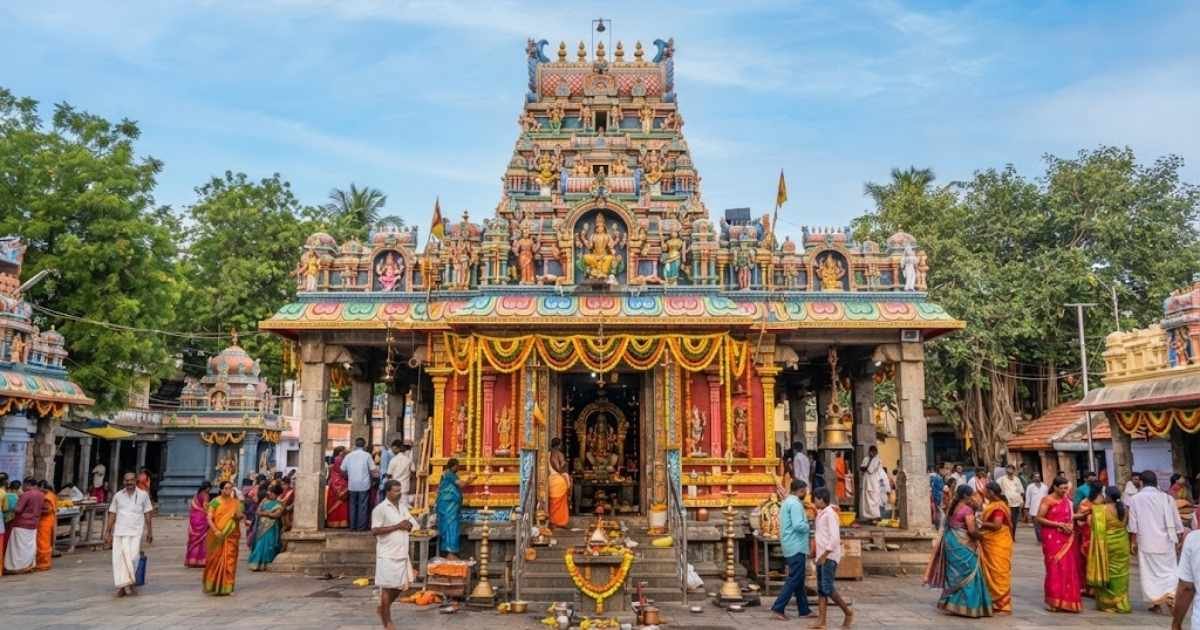
Maisigandi Maisamma Temple is a well-known Shakti shrine on the Hyderabad to Srisailam highway (NH 765) in Kadthal mandal, Ranga Reddy district, Telangana. It is dedicated to Goddess Maisamma, a village guardian deity worshipped as a form of Mahakali. The temple is famous for its 20-foot idol and a sanctum that stays open to the sky.
Many people search for it with “Hyderabad” in the name, but it sits roughly 55 to 66 km outside the city. This guide covers history, timings, festivals, transport and etiquette. It was last checked in September 2026.
Quick facts
- Deity: Goddess Maisamma (gramadevata, Mahakali form)
- Address: Maisigandi village, Srisailam Highway, Kadthal mandal, Ranga Reddy district, PIN 509358
- Distance: about 55 to 66 km from Hyderabad, about 73 km from Secunderabad
- Timings: roughly 6 AM to 1 PM and 4 PM to 8:30 PM
- Entry: free
- Main festivals: Bonalu (Ashada month) and the annual Jatara (Karthika month)
- Reported contact number: 097054 62088 (confirm before you travel)
Do not confuse it with: Gandi Maisamma Temple near Bachupally Road, Gattu Maisamma at Ghatkesar, or Katta Maisamma at Sunnam Cheruvu. These are separate temples in and around the city. Searching “Maisigandi Maisamma Temple, Kadthal” on your map app saves a wasted trip.
Historical Background of Maisigandi Maisamma Temple
The main shrine has no royal inscription and no recorded founding date. Its story lives in oral tradition, which is normal for village goddess temples. Some websites say it is over 500 years old. I could not find any record that supports a specific age, so treat that number as unverified.
Two local accounts explain how the goddess came to be worshipped here:
- The cowherd story. A cowherd found an idol in the pastures near the village and told the villagers. They began worshipping at that spot.
- The neem tree story. Telugu media reports say Maisamma appeared on her own beneath a neem tree, in the wall of an old fort bastion. At first there was only a small stone form. A devotee later helped install the larger idol.
The details differ, but both versions share one idea. The goddess chose the place herself.
The modern temple grew through community effort. Banjara leader Panthu Naik, the founder trustee, is credited with building its administration and facilities. His family and community members continue to run it. Reports also mention Endowments Department involvement in Jatara arrangements and periodic hundi counting.
Close by stand older Shiva, Rama and Annapurneshwari temples near a stone tank. A Telugu report says inscriptions link them to Akkanna and Madanna, ministers at the court of the Golconda ruler Tana Shah. That suggests the area was sacred long before the tall idol arrived.
Read More: Komuravelli Mallanna Temple: History, Timings, Significance & Complete Visitor Guide
Who Is Goddess Maisamma?
Maisamma is a gramadevata, a village guardian goddess worshipped across Telangana. Devotees see her as a local form of Mahakali and Adi Shakti. She is fierce with evil and gentle with her children.
People traditionally turn to her for:
- Protection from disease, drought and the evil eye
- Relief from family conflict and money trouble
- Success in court cases and business
- Marriage alliances and childbirth
Maisamma is not approached through strict Agama rules. Devotees speak to her like a mother, make a vow and return with a thank-you offering. Telugu reports call her “kongubangaram”, which means gold tied at the end of a sari, always within reach.
Village goddesses usually guard the boundary of a settlement. Here she guards a highway. Travellers heading to Srisailam often stop for a quick darshan before they continue.
Spiritual Significance of Maisigandi Temple
The temple matters for three reasons.
It is a wish-fulfilment shrine. Devotees make a vow (mokku) and offer bonam once their prayer is answered.
It is a travellers’ shrine. Buses toward Kalwakurthy, Achampet and Srisailam are reported to pause here, and many passengers step down for a moment.
It is a shared space. Telugu reports say Hindus, Muslims and Christians all come to pray.
For the Banjara (Lambada) community, it is also a marker of identity. The priests come from the community, and their devotional style stays visible on a busy national highway.
Temple Architecture & Layout
Do not expect carved Dravidian stone towers. The temple is modern, and its appeal lies in a few striking features:
- 20-foot idol: Goddess Maisamma dominates the sanctum, dressed in bright cloth and flowers.
- Open-top gopuram and sanctum: The structure above the goddess is open to the sky. Devotees say she prefers to stay under the open heavens.
- Decorated mound (putta): Visitor listings describe the base of the idol as decorated with mirrors and offerings.
- Pradakshina path: A walkway circles the shrine, and devotees usually make three rounds.
- Foot-washing point: Placed near the entrance.
- Subsidiary shrines: Rama, Anjaneya and Shiva, plus a large stepped tank called the koneru. Sources differ on whether these sit inside the complex or about half a kilometre away.
- Open parking: Available near the complex.
The sanctum is open, so the ground gets hot around noon. In summer, arrive early or after 4 PM.
Rituals, Poojas & Offerings
Daily worship follows a village style, not strict Agamic procedure. Reports describe morning and evening aarti led by Banjara priests. Abhishekam, fresh flower decoration, camphor lamps and incense are part of the routine.
Common offerings include:
- Coconuts, lemons and flowers
- Turmeric and kumkum
- Sarees, blouses and bangles for the goddess
- Oil lamps and incense
- Bonam, a cooked meal offered as thanks after a vow is fulfilled
A typical visit flows like this, though details can vary by day:
- Wash your feet near the entrance.
- Buy coconut, flowers and other items from the counters.
- Join the darshan queue.
- Hand your offerings to the priests and receive kumkum or turmeric.
- Walk around the shrine three times.
- Collect prasadam and sit quietly for a few minutes.
Guides say Maisigandi today stresses vegetarian, symbolic offerings. Still, ask the staff what is allowed inside the premises.
Festivals Celebrated at Maisigandi Temple
Three occasions stand out. Crowds also swell during Dasara Navratri and on Amavasya days.
Bonalu
Bonalu falls in the Ashada month, usually July to August. Women carry decorated bonam pots on their heads. The pots hold cooked rice, jaggery and milk or curd, often with neem leaves and turmeric. Drums, folk songs and Lambadi dances fill the approach road.
Telugu reports note that goddess temples across Telangana hold special poojas on Sundays, Mondays and Tuesdays in Bonalu season, so expect a similar pattern here. The 2026 season has ended. The next one comes in Ashada 2027.
Jatara (Annual Temple Fair)
The annual Jatara is held around Karthika Pournami. The 2025 edition ran from 5 to 10 November. Reported highlights were:
- Ksheerabhishekam and a special harati on day one
- A multi-day Sahasra Chandi Yagam that ended with Purnahuti on day four
- Closing rituals of bonam offerings and Bandlu Tippudu, a traditional cart ritual
- Stalls selling sweets, crafts and devotional items, with Banjara folk music
In 2026, Karthika Pournami falls around 23 to 24 November, so expect the Jatara in late November. The exact schedule is announced shortly before it starts, so confirm it locally.
Batukamma Festival
Batukamma, spelled Bathukamma in most sources, is Telangana’s nine-day flower festival. In 2026 it runs from about 10 October to Saddula Bathukamma on 18 October, with Dasara on 20 October.
Local guides say the temple gets heavier crowds during this season. I found no separate temple-run Bathukamma programme, so plan for a busy day, not a ticketed event.
Miracles & Devotee Beliefs
Belief sits at the heart of this temple. Devotees speak of recovery after long illness, delayed marriages finally settling, court cases ending well and children arriving after years of waiting. Safe escapes on the road are another common story.
These accounts cannot be independently verified. They belong to faith, not proof. Please keep seeing your doctor or lawyer alongside your prayers.
One Telugu news report has covered sunlight falling directly on the idol, something an open-sky sanctum makes possible. Many devotees read such moments as a sign. The temple’s reputation has grown mostly by word of mouth, which is how village shrines have always grown.
Maisigandi Maisamma Temple Timings
Guides list slightly different hours, so use this as a planning range:
| Session | Usual timing |
| Morning darshan | 6:00 AM to about 1:00 PM |
| Afternoon break | about 1:00 PM to 4:00 PM |
| Evening darshan | about 4:00 PM to 8:30 PM |
| Festival days | Often extended |
Sources put closing time between 8:00 and 8:30 PM. The temple has also been reported to close or adjust its schedule during eclipses. Call 097054 62088 before a long drive, and always before the Jatara.
Special Days and Auspicious Occasions
- Tuesdays and Fridays: Traditional goddess days across Telangana.
- Sundays: Family day and the busiest weekend slot. Telugu reports mention special poojas on Sundays, Tuesdays and Thursdays.
- Amavasya (new moon): Larger gatherings.
- Bonalu Sundays: The peak of the Ashada season.
- Jatara days: Around Karthika Pournami.
- Navratri and Dasara: Extended prayers, with 2026 celebrations around 11 to 20 October.
Sundays and Tuesdays appear in nearly every source. Other days vary.
Prasadam and Sacred Offerings
Prasadam commonly includes coconut pieces, banana, turmeric-smeared rice, kumkum and lemon. Sweet pongal is served on some festival days. During Bonalu and Jatara, bonam is shared among devotees.
Local Banjara families run food stalls outside. Older guides praise the country chicken with jowar roti. It is not prasadam. Vegetarians will find other options, but ask before you order. Keep small notes handy for offerings and pooja items.
Cultural Importance of Maisigandi Temple
This temple is a living cultural space, not only a place of worship.
- It keeps Banjara and Lambada traditions visible: bright ghagra-cholis, heavy silver jewellery, dhol beats and community dances.
- It runs on community stewardship, not royal or dynastic patronage.
- It welcomes people of many faiths.
- It supports a small roadside economy of pooja shops and food stalls.
- It links city devotees to rural festival life within a two-hour drive.
Read More: Falaknuma Kali Mata Temple Hyderabad – History, Significance, Timings & Complete Darshan Guide
How to Reach Maisigandi Maisamma Temple
By road (best option): From Hyderabad, take the Outer Ring Road or the LB Nagar side and join NH 765 toward Srisailam. Pass Kadthal town. The temple is roughly 3 km further along, on the Srisailam side. Driving takes 1.5 to 2 hours depending on traffic.
By cab or auto: App cabs run from central Hyderabad. Autos and local cabs are available from Kadthal bus stop.
By bus: See the bus section below.
Road conditions are good on the highway. The last stretch uses village roads, so drive slowly. Parking is available but fills up on festival days.
Nearest Metro and Railway Stations
- Metro: No Hyderabad Metro station is close to this temple. Some online guides list a metro stop that belongs to a different Maisamma temple in the city, so ignore those. The practical option is to ride the metro to MGBS or JBS and take a bus from there.
- Railway: Shadnagar (SHNR) is the commonly used station, roughly 34 km away by rail-enquiry listings. For long-distance trains, use Secunderabad, Hyderabad Deccan (Nampally) or Kacheguda, then continue by road.
- Airport: Rajiv Gandhi International Airport at Shamshabad is the closest, roughly an hour’s drive.
Maisigandi Temple Bus Route Timings
I could not find a temple-specific timetable. The workable approach is to board a TGSRTC (formerly TSRTC) bus on NH 765 toward Kadthal, Kalwakurthy, Achampet, Srisailam or Mahabubnagar.
- Boarding points: MGBS, JBS, CBS and Tukkuguda.
- Frequency: TSRTC’s 2024 schedule for Srisailam services showed the first bus from MGBS around 3:30 AM and the last around 11:45 PM, roughly every half hour. Check the current timetable.
- Best departure: 6 AM to 8 AM, which puts you at the temple by mid-morning.
- Travel time: About 1.5 to 2 hours.
- Tell the conductor: Ask for “Maisigandi temple” so you get off at the right stop.
- Return: Wait at the highway stop for any Hyderabad-bound bus. Confirm the last service before you leave, especially outside peak season.
Secunderabad to Maisigandi Temple Distance
The road distance from Secunderabad to Maisigandi Maisamma Temple is about 73 km. The drive takes 1.5 to 2 hours. A common route is Secunderabad to LB Nagar or the ORR, then NH 765 through Kadthal.
Other useful distances:
- Hyderabad city: About 55 to 66 km, depending on your starting point and the source
- Uppal X Roads: About 59 km
- Kadthal town: About 3 km
- Kalwakurthy: About 34.5 km
- Srisailam: Roughly 150 to 160 km further on the same highway
Best Time to Visit Maisigandi Temple
- Weekday mornings: Quiet darshan and short queues.
- Sundays and Tuesdays: Livelier, with more devotees and a stronger festive mood.
- October to February: Pleasant weather for an open-air temple.
- Bonalu and Jatara: Best for culture, worst for crowds.
- Summer afternoons: Avoid them. The sanctum has no roof.
- Monsoon: Check road conditions before leaving.
Coming up in 2026: Bathukamma and Dasara in October, and the Jatara around late November.
Temple Etiquette and Dress Code
- Wear modest, comfortable clothing. Sarees, salwar kameez, kurta-pyjama or dhoti all work.
- Remove footwear before entering the premises.
- Avoid photography near the sanctum. Follow the signs and the priests’ instructions.
- Do not touch the idol or offerings without permission.
- Keep your phone on silent and your voice low during aarti.
- Carry a cap, water and some cash.
- Watch children and bags in a crowd.
- Ask before photographing other devotees.
- Do not litter near the tank or the stalls.
Devotee Beliefs and Experiences
Devotees describe a personal relationship with the goddess. They ask for something specific, promise an offering and return to keep that promise. A visit is often a family outing, with the trip planned around a bonam.
Faith here is practical. People pray for health, weddings, court cases and prosperity, then say thanks in public through bonam and Jatara rituals.
Maisigandi Temple and Telangana Folk Faith
Maisigandi belongs to the gramadevata tradition, which is older than the region’s large temple culture. Village goddesses such as Maisamma, Pochamma, Yellamma and Peddamma protect a community’s land, health and harvest. Worship is led by local priests, includes folk music and centres on women carrying bonam.
In Hyderabad, Golconda, Lal Darwaza and Ujjaini Mahankali are among the best-known Bonalu temples. Maisigandi is where the same tradition plays out on a highway. In Mulugu district, the Medaram Sammakka Saralamma Jatara (held 28 to 31 January 2026) shows how large this folk faith can grow.
Why You Should Visit Maisigandi Maisamma Temple?
- See a 20-foot goddess idol under an open sky, which is rare in the region.
- Experience folk Shakti worship without heavy ritual or ticket queues.
- Meet Banjara culture through music, dress and festival food.
- Time it with Bonalu or the Jatara for colour and community energy.
- Combine it with a Srisailam trip as a natural highway stop.
- Enjoy an easy day out from Hyderabad, with free entry and simple logistics.
Frequently Asked Questions
Where is Maisigandi Maisamma Temple located?
It is in Maisigandi village, Kadthal mandal, Ranga Reddy district, on the Hyderabad to Srisailam highway (NH 765), about 3 km from Kadthal.
What are the Maisigandi Maisamma Temple timings?
The temple is usually open from about 6 AM to 1 PM and 4 PM to 8:30 PM. Hours extend on festival days, so call 097054 62088 to confirm.
Is Maisigandi Temple the same as Gandi Maisamma Temple?
No. Gandi Maisamma is a separate temple near Bachupally Road in Hyderabad’s northwest. Maisigandi is on the Srisailam highway in Kadthal.
How far is Secunderabad from Maisigandi Temple?
It is about 73 km by road, roughly 1.5 to 2 hours by car via the ORR or LB Nagar and NH 765.
How can I reach Maisigandi Temple by bus?
Take a TGSRTC bus toward Kadthal, Kalwakurthy, Achampet or Srisailam from MGBS, JBS or CBS. Ask the conductor to stop at the Maisigandi temple.
Is there an entry fee at Maisigandi Maisamma Temple?
No. Darshan is free. You only pay for pooja items or offerings you choose to buy.
Which day is best to visit Maisigandi Temple?
Sundays and Tuesdays are the most cited days, and Fridays are also popular. Weekday mornings are calmer.
When is the Maisigandi Maisamma Jatara?
It is held around Karthika Pournami. The 2025 Jatara ran from 5 to 10 November, and the 2026 fair is expected in late November.
What is special about the idol at Maisigandi Temple?
The goddess idol is about 20 feet tall and stands in a sanctum that is open to the sky.
What should I wear to Maisigandi Temple?
Wear modest traditional or comfortable clothing and remove footwear before entering. Carry a cap for the open-air sanctum.
Conclusion
Maisigandi Maisamma Temple shows that a shrine does not need carved stone to leave an impression. It has a tall goddess, an open sky, a strong Banjara tradition and devotees who arrive with vows and leave with thanks.
If you plan to go, pick your day with care. Choose a weekday morning for quiet, or Bonalu and the Jatara for full festival energy. Confirm timings by phone, carry water and a cap, and dress modestly. Search the exact temple name on your map so you do not land at a different Maisamma temple.
May your visit be peaceful, and may the Ammavaru bless your journey.