
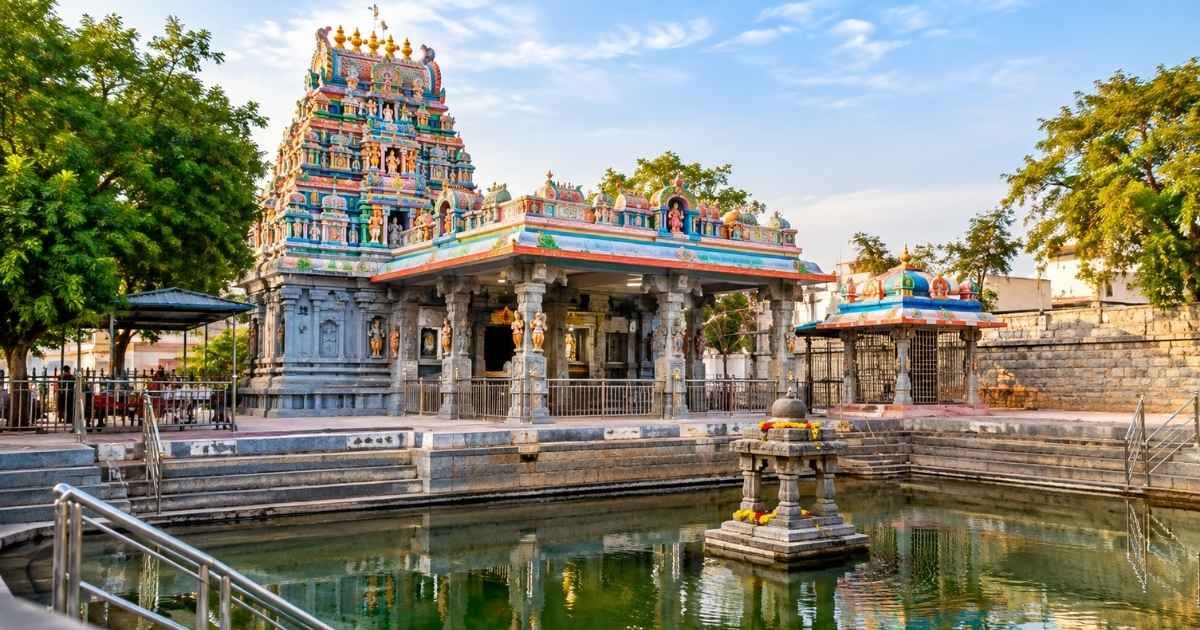
Kashi Bugga Temple sits on the bank of the Musi River in Kishan Bagh, Hyderabad. It is a small Shiva shrine with a rare feature. The lingam is placed below ground level, and water keeps flowing over it through the day.
This guide covers history, timings, location, rituals, festivals and transport. It also clears up two common mix-ups. The Kashi Bugga stampede in the news happened at a different temple in Andhra Pradesh. And several unrelated temples carry the word “Bugga” in their names.
Details were checked against news reports, listings and visitor accounts in October 2026. Timings and bus numbers change, so confirm before you travel.
Quick facts
- Location: Kishan Bagh, Hyderabad 500064, beside the Musi River
- Main deity: Lord Shiva, as an underground lingam
- Founded: 1822, per Endowments Department records
- Usual timings: 6:00 AM to 12:00 PM and 5:00 PM to 8:00 PM
- Entry: Free
- Distance from Charminar: About 5 km
Kashi Bugga Temple History
The Telangana Endowments Department credits Raja Raghu Ramji with founding the temple in 1822. His family still looks after it, and Nanda Kumar is the current family trustee.
Sources do not fully agree. A 2013 Hyderabad heritage blog gives 1814 as the year of construction. The Endowments record is the official one, so 1822 is the safer date to quote. Either way, the temple is about 200 years old.
For decades it stayed off the map. One devotee told The Hans India that on an early visit he found only stray dogs and a large tree. Interest grew through word of mouth about the temple’s Stala Purana, the local tradition tied to the site.
Devotees also describe Sri Murali Manohar Swamy Temple as the main temple under the Kashi Bugga name, and some map listings call the place Chitraguptha Swamy Temple.
The Mystery Behind the Name
The name has two parts. Kashi means Varanasi, the holiest city for Shiva worship. Bugga is a Telugu word for a spring or natural water seep. Together they suggest a spring carrying the sanctity of Kashi.
The mystery is the water. Devotees describe a flow with no known source and call it Kashi water. I found no published geological study, so its origin remains a matter of belief rather than record.
Do not confuse this temple with others that share the word:
- Bugga Ramalingeswara Swamy Temple, Tadipatri: Located in Anantapur district and named for a stream flowing below it.
- Bugga Rameshwaram near Vikarabad: About 78 km from Hyderabad and described as the source of the Musi.
- Kasibugga, Srikakulam: A town in Andhra Pradesh and the site of the 2025 stampede.
Spiritual Significance of Kashi Bugga Temple
The faith here rests on one thing, the Nitya Jalabhishekam. It means the lingam is bathed in flowing water without a break. Devotees say the deity’s presence fulfils wishes and brings good fortune.
Three beliefs shape most visits:
- Prayers here are seen as carrying the same merit as a visit to Varanasi.
- The water is considered holy and is collected as prasadam.
- Some devotees believe the water has healing power.
A note of balance: the healing claim is faith, not medical evidence. Keep following your doctor’s advice and treat the water as a spiritual offering.
Mondays, Pradosham evenings, Karthika Masam and Maha Shivaratri are the most devotional days.
Read More: Dilsukhnagar Sai Baba Temple: Timings, Aarti & Full Guide
Temple Architecture and Structure
Do not expect a towering gopuram. Local accounts describe a temple built to resemble an ordinary house, with the sacred part hidden inside. Some online guides mention grand Dravidian gateways, which does not match visitor descriptions. Go for the experience, not ornate stonework.
Key Architectural Features
- Underground sanctum: Steps lead down to a lingam set below ground level.
- Flowing water: A constant stream passes over the lingam.
- Entrance tree: A large tree at the entrance houses Rahu and Ketu, the serpent deities.
- Sitting space: A platform near the tree is used for meditation and chanting.
- Compact premises: Reviewers mention a small compound with limited parking.
The steps are the main challenge. Elderly visitors should go with someone who can steady them.
Deities Worshipped in the Temple
Lord Shiva is the main deity, worshipped as an underground lingam. Many guides call it Swayambhu, meaning self-manifested, which is a devotional belief.
Other presences include:
- Sri Murali Manohar Swamy: A form of Krishna, whose temple devotees call the main one under Kashi Bugga.
- Rahu and Ketu: Enshrined at the entrance tree.
- Chitragupta: A name used by some listings.
Kashi Bugga Temple Incident
On Saturday, 1 November 2025, a crowd crush at Sri Venkateswara Swamy Temple in Kasibugga, Srikakulam district, killed devotees gathered for Kartika Ekadashi. Reports gave a death toll between nine and twelve, and the district collector said ten. Police said devotees panicked after an iron railing was damaged, and a case was filed against the temple owner.
Officials said the temple was private and not under the Endowments Department. It is a separate place from the Shiva shrine in Kishan Bagh. I found no credible report of a similar incident at the Hyderabad temple.
- Avoid peak hours on Ekadashi, Mondays and Shivaratri.
- Keep children and elders close, and fix a meeting point.
- Follow priests and volunteers on queues.
- Never push toward steps or exits.
Kashi Bugga Temple Puranapool
Many people search “Puranapool” because it is the best known landmark near the temple. Purana Pul is the old bridge over the Musi in the Old City, and Kashi Bugga sits on the same river. One guide lists it about a 26 minute walk away.
What to know:
- Devotees can reach the temple by walking over a low footbridge across the Musi from the Jiyaguda area.
- A plan for a higher footbridge was studied but shelved.
- The same report notes that no signboard guides visitors in the Old City.
- A reviewer mentions Ichapuri Bholenath Mandir, another Shiva temple, on the other side of the bridge.
Set your map destination to the temple, not Purana Pul. Skip the low footbridge if the river is running high.
Kashi Bugga Temple Distance
| From | Approximate distance |
| Charminar | 5 km, 20 to 30 minutes by road |
| Nehru Zoological Park | About 2 km |
| Attapur Pillar 143 | About 2.4 km |
| Purana Pul | About 26 minutes on foot |
| Nampally station | 9 to 10 km |
| Airport (HYD) | Roughly 20 to 30 km, sources vary |
These figures come from visitor guides and map listings, so treat them as estimates. Old City traffic can double travel time in the evening.
Read More: Japali Hanuman Temple: Timings, History, Location & Travel Guide 2026
Festivals Celebrated at Kashi Bugga Temple
Maha Shivaratri
The biggest night, falling in February or March. Guides describe night-long vigils, continuous abhishekam and chanting. Expect long queues. For a calmer visit, come early evening or the next morning.
Karthika Masam
Falls around October to November. Lamp lighting, special poojas and daily abhishekam are reported, with Mondays packed. Ekadashi in this month draws very large crowds, so plan with care.
Shravan Mondays
Shravana (July to August) brings Shiva fasts. Each Monday sees large gatherings and extra prayers.
Navaratri
Held in September or October and centred on the Goddess. Since this is a Shiva temple, expect a quieter observance, though some guides mention cultural programmes.
Pradosham
Observed twice a month on the thirteenth lunar day. The twilight hour is considered ideal for Shiva worship, so the evening session sees steady crowds.
Kashi Bugga Temple Timings
| Session | Usual timing |
| Morning | 6:00 AM to 12:00 PM |
| Evening | 5:00 PM to 8:00 PM |
Listings differ on closing time. Most say 8:00 PM, while some say 9:00 PM. One listing shows Mondays running from 6:00 AM to 1:30 PM and 5:00 PM to 9:30 PM.
- Entry is free, and abhishekam needs a ticket from the counter.
- The temple closes through the afternoon.
- Arrive 30 minutes before closing.
- Festival days can change the schedule.
Best Time to Visit the Temple
Time of Day
Early morning, soon after 6:00 AM, is the calmest. Weekdays are quieter than weekends. The evening session suits lamp-lit prayer, but Mondays get crowded.
Time of Year
- October to February: Cooler weather for the walk and the steps.
- Maha Shivaratri and Karthika Masam: Festive, but crowded.
- April to June: Very hot, so avoid midday.
- Monsoon: Check the river level before using the footbridge.
How to Reach Kashi Bugga Temple
The address is Kishan Bagh, Hyderabad 500064. Listings also use Mahmood Nagar or Shariff Nagar. The Google Maps Plus Code is 9C4V+47Q.
By Road
- An auto or cab from Charminar takes 20 to 30 minutes.
- Guides list buses 252N, 2Z, 532, 94H and 95 for the area, with Jalva Hotel as the nearest stop and a walk of about six minutes. Confirm routes in the TGSRTC app, since numbers get revised.
- Parking is a known problem, so public transport or a cab is easier.
By Rail
Hyderabad Deccan (Nampally) is the nearest major station, about 9 to 10 km away. Take an auto or cab from there.
By Air
Rajiv Gandhi International Airport at Shamshabad is the nearest airport. Prepaid taxis and app cabs run to Kishan Bagh.
Nearby Attractions
- Charminar: The Old City icon, 5 to 6 km away.
- Chowmahalla Palace: A Nizam era palace.
- Mecca Masjid: One of India’s oldest large mosques.
- Musi riverbank: A quiet spot beside the temple.
- Nehru Zoological Park: About 2 km away.
- Sudha Cars Museum: A short drive away.
Devotional Practices at the Temple
- Abhishekam: Buy a ticket and bathe the lingam. Reviewers say to carry panchamrutham from outside.
- Archana: Visitors describe the priest offering prayers in the family’s name.
- Pradakshina and japa: Circle the sanctum and chant quietly.
- Annadanam: Free meals on special occasions.
Spiritual Experience for Visitors
Visitors describe a calm that begins at the steps. The chamber is cool, the sound of water is constant, and the space is small enough to feel personal. Reviewers call the temple well kept despite its size, with a peaceful riverside setting. Go without a rush, sit for a few minutes, and let the visit be slow.
Preservation and Community Support
After years of neglect, the temple has revived through growing awareness. The Endowments Department records it, and the founding family manages it through a trustee. Gaps remain: no signboards, tight parking and a shelved bridge proposal.
How visitors can help:
- Visit off peak.
- Carry your litter back.
- Insist on official receipts.
- Park without blocking local lanes.
FAQ’s
What is Kashi Bugga Temple famous for?
Its underground Shiva lingam, bathed by a continuous stream of water called Nitya Jalabhishekam.
Where is Kashi Bugga Temple located?
In Kishan Bagh, Hyderabad, Telangana 500064, on the bank of the Musi River.
What are Kashi Bugga Temple timings?
Usually 6:00 AM to 12:00 PM and 5:00 PM to 8:00 PM, though some listings show 9:00 PM. Confirm before festival days.
Is there an entry fee for Kashi Bugga Temple?
No, entry is free. Abhishekam and special poojas need a ticket.
Why is it called Hyderabad’s Kashi?
Devotees believe prayers beside the flowing Kashi water bring merit similar to a visit to Varanasi.
Who built Kashi Bugga Temple?
Raja Raghu Ramji founded it in 1822, per Endowments records, and his descendants manage it.
What is the best time to visit Kashi Bugga Temple?
A weekday morning is calmest. October to February has the best weather.
How far is Kashi Bugga Temple from Charminar?
About 5 km, roughly 20 to 30 minutes by road depending on traffic.
Can I perform abhishekam at the temple?
Yes. Buy a ticket at the counter and carry your own panchamrutham if you wish.
What buses go to Kashi Bugga Temple?
Guides list TSRTC (now TGSRTC) buses 252N, 2Z, 532, 94H and 95. Get off at Jalva Hotel stop and walk about six minutes.
Conclusion
Kashi Bugga Temple is small, plain from the outside and unusual within. The underground lingam, the unbroken flow of water and the quiet riverside setting make it one of the most distinctive Shiva temples in Hyderabad.
Plan for a weekday morning, carry panchamrutham if you wish to perform abhishekam, and use the temple’s map pin since signboards are scarce. Keep the Srikakulam incident in mind as a reminder to avoid peak crowds. Visited with patience, this old shrine on the Musi rewards the effort.