
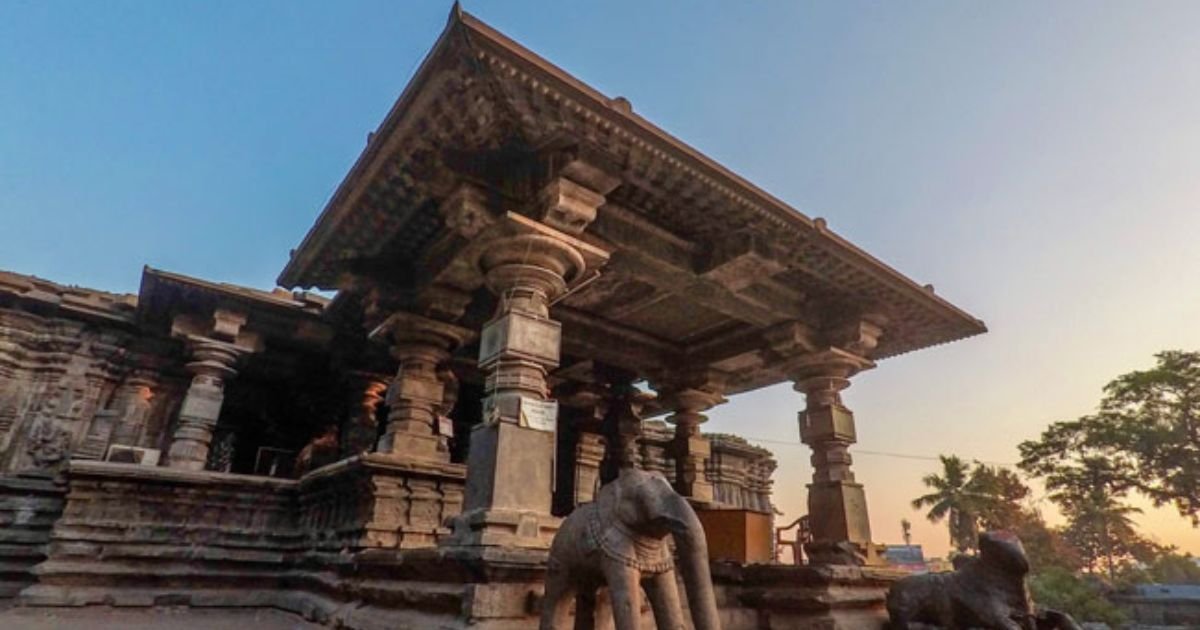
Look closely at the temple wall in Hanamkonda. The stone looks carved from one smooth piece, yet it holds thousands of tiny details. This is the Thousand Pillar Temple, also called Rudreshwara Swamy Temple, a 12th century Kakatiya masterpiece that still holds daily worship.
This guide covers its history, architecture, timings, tickets, reviews and travel routes. It also explains what is true and what is myth, such as the UNESCO claim and the exact pillar count.
Thousand Pillar Temple History
King Rudra Deva of the Kakatiya dynasty built the temple in 1163 CE and named it Sri Rudreshwara Swamy Temple. One report says the main Linga was installed on 19 January 1163, which matches a tradition of dating it to Magha Shuddha Trayodashi. A few pages print other date ranges, but 1163 is the most cited year.
The temple sits in Hanamkonda, which was an early Kakatiya centre before the capital moved to Warangal under Ganapati Deva. Local tradition says Rudra Deva built the temple out of devotion to Shiva.
The temple is also called Veyyi Sthambhala Gudi in Telugu, which simply means “Thousand Pillar Temple.”
Why Is It Called the Thousand Pillar Temple?
The name sounds like a plain count, but the truth is more interesting.
- The pillars are many and tightly packed. They stand so close that they look like a wall.
- Vertical carvings make them look like more. Many columns have repeated carved lines that create an illusion of endless rows.
- One report gives a rough breakdown. It says the facade has about 600 pillars and the dance pavilion carries about 400.
- A neat design feature. No pillar blocks your view of another shrine from any direction.
So “thousand” is both a figure and an impression. Some pages say exactly 1,000, while others call it symbolic. Both views exist.
Architectural Brilliance of the Kakatiyas
The temple is built on a star-shaped platform, about one metre or six feet high. Three shrines sit on this base, dedicated to Shiva, Vishnu and Surya. This triple-shrine plan is called a Trikutalayam.
Key features:
- Three shrines linked by a square mandapa
- Shiva’s shrine faces east, while the other two face south and west
- Star-shaped plan that adds many corners for carving
- Perforated stone screens that let in light and air
- Rock-cut elephants along the platform
- Richly carved doorways with fine figures
Experts call it a fine example of the Kakatiya style, which borrowed from earlier Chalukyan star-shaped temples but added its own polish and detail.
Read More: Karnataka Temple Accommodation: Full Booking Guide 2026
The Magnificent Nandi Statue
A six-foot Nandi bull sits in front of the Shiva shrine. It is carved from a single block of black basalt or dolerite. Its surface is polished to a shine, and the carving is sharp even today.
The Nandi was damaged over the centuries. Recent restoration work repaired parts such as the tail and the folded leg. Many visitors say the Nandi is the best reason to stop here, even if you have only a few minutes.
Pillars That Speak Art and Science
The pillars are not just decoration. They show how Kakatiya builders mixed art with engineering.
- Polished surfaces: Some pillars have a mirror-like finish that catches light.
- Load planning: Dense columns share the weight of the heavy roof slabs.
- Open sight lines: The layout lets worshippers see each shrine clearly.
- The sandbox foundation: Builders dug deep pits, filled them with sand, lime and rubble, and built on top. The ASI reportedly found a sand pack about 30 feet deep under the dance pavilion. This worked like a shock absorber, a clever way to protect heavy stone on loose ground.
Sculptural Excellence and Iconography
Sculptors carved gods, dancers, musicians, animals and floral patterns into the stone. The doorway of the Shiva shrine is especially admired. The ceiling slabs and four central pillars of the mandapa have fine figures.
Look for:
- Dancers and musicians on the pillars
- Perforated screens with geometric patterns
- Door jambs with layered carving
- Small shrines with Lingas in the surrounding garden
Religious and Spiritual Significance
The temple honours three deities, which shows the Kakatiya spirit of inclusion. Shiva is the main deity, so the temple is known as Rudreshwara Swamy Temple. Vishnu and Surya have their own shrines.
It is still an active place of worship. Devotees offer prayers daily, and Maha Shivaratri is a major occasion. A temple pond sits within the premises, and visitors often comment on how clean and calm the area feels despite the busy road outside.
Read More: Dilsukhnagar Sai Baba Temple: Timings, Aarti & Full Guide
Destruction, Decline, and Restoration
The temple’s story includes loss and recovery.
- Early 14th century: The Kakatiya kingdom fell to forces under Ulugh Khan around 1323 to 1324. The dance pavilion was ransacked and left in ruins for centuries.
- Foundation problems: A geological fracture reportedly weakened the old sandbox base, and the heavy Kalyana Mandapam slowly sank.
- Nizam era support: Reports credit the Nizam of Hyderabad with helping preserve and rebuild parts of the temple.
- 2004 and 2005: The ASI carried out renovations. In 2005, the Government of India sanctioned ₹3 crore for the Kalyana Mandapam, which was then taken apart stone by stone.
- 2012: Road widening led to the clearing of nearby structures, which gave the restoration new momentum.
- 2026 reports: The ASI is reported to have completed a 42-year restoration of the dance pavilion using the Kakatiya sandbox method. The Nandi was also repaired.
Older pages still say the main hall is closed. If you visit, expect some areas to be cleaned, fenced or still being finished.
Thousand Pillar Temple Timings
Reported timings differ, so use this as a guide:
| Source pattern | Time |
| Most common | 6:00 AM to 8:00 PM daily |
| Some listings | 5:00 AM to 9:00 PM |
| A few listings | 6:00 AM to 6:00 PM |
| One 2026 guide | A midday rest from about 12:00 PM to 4:00 PM |
The temple is open all days of the week. Festival days may change the hours. If you want to see the stonework in good light, go between 8:00 AM and 11:00 AM or after 4:00 PM. Confirm the day’s hours before a long trip.
Location and How to Reach
Address: Hyderabad to Warangal Highway, Brahmanawada, Hanamkonda, Telangana 506011 (some listings use 506001)
The temple lies between Warangal and Hanamkonda, close to the main road.
By road: The temple is about 150 km from Hyderabad, a drive of roughly 3 to 3.5 hours via NH163, which connects Hyderabad, Bhuvanagiri and Warangal. TSRTC buses and private cabs run often.
By train: The nearest stations are Warangal (about 6 km) and Kazipet Junction (about 7 km). Many trains stop at Kazipet.
By air: The nearest major airport is Rajiv Gandhi International Airport, Hyderabad, roughly 150 to 170 km away. Hire a cab from there.
Local travel: Autos and shared autos run from the stations. Shared rides were reported at about ₹20 per head in older answers, and a private auto or cab costs more.
Warangal Railway Station to 1000 Pillar Temple Distance
The distance is about 6 km from Warangal Railway Station. An auto ride takes around 15 to 25 minutes depending on traffic. From Kazipet Junction, it is about 7 km.
Tips:
- Agree on the fare before boarding an auto.
- Use a ride app if available.
- Tell the driver “Veyyi Stambhala Gudi” if they do not know the English name.
Best Time to Visit
October to March is the best period. The weather is cooler, so you can walk around the complex without heat. Summer afternoons are hot, and the black stone can feel warm.
For a festival visit, Maha Shivaratri is the main draw. Early morning and late afternoon are best for photos and for a quiet look at the carvings.
Importance for Exams (UPSC & State PSC)
This temple shows up in history and art questions. Key points to remember:
- Builder and year: Rudra Deva, Kakatiya dynasty, 1163 CE
- Name: Rudreshwara Swamy Temple, also Veyyi Sthambhala Gudi
- Plan: Trikutalayam, three shrines for Shiva, Vishnu and Surya, on a star-shaped platform
- Material: Mostly stone, with a monolithic Nandi in black basalt or dolerite
- Technology: Sandbox foundation for earthquake and settlement resistance
- Restoration: ASI rebuilt the Kalyana Mandapam over decades
- UNESCO status: Tentative list only, along with Warangal Fort and Kakatiya Kala Thoranam
- Do not confuse: Ramappa Temple (Palampet) is the UNESCO World Heritage Site, listed in 2021
Related topics include the Kakatiya dynasty, Ganapati Deva, Rani Rudrama Devi, Warangal Fort and Kakatiya water tanks.
Read More: Thiruthani Murugan Temple: Timings, History, Darshan & Travel Guide 2026
Cultural Legacy of the Thousand Pillar Temple
The temple is a symbol of Telangana’s identity. Warangal and Hanamkonda are known for Kakatiya heritage, and this temple is one of the best-known monuments from that era. Local artists, students and historians often use it as a reference point.
Its dance pavilion also reflects the Kakatiya love of performing arts, including temple dance traditions. The restoration has brought fresh attention to Kakatiya engineering, and it keeps the memory of a lost period alive for new visitors.
Thousand Pillar Temple Tickets
Entry is free for all visitors. No ticket is needed for darshan or to walk in the temple complex.
Related costs:
- Camera fee: Older reports mention a small fee (about ₹20) for still photography, and a higher one for video. Rules and amounts may have changed.
- Parking: Check at the entrance, as small fees may apply.
- Museum or ASI sites nearby: These may charge separate entry.
Photography rules vary between sources. Most say photos are fine in open areas and not inside the sanctum. Ask staff at the gate.
Thousand Pillar Temple Reviews
Visitor reviews are mostly positive. Common themes include:
- Praise for the carving: The doorway of the Shiva shrine and the Nandi are often singled out.
- A working temple: Reviewers note that it is clean and still active, not just a ruin.
- Restoration work: Older reviews mention scaffolding and closed areas, while newer ones note the improved look.
- Quiet pond and lawn: Visitors enjoy a short rest in the garden.
- A short visit: Most people spend 45 minutes to an hour, though history lovers stay longer.
A few visitors wish for better signage and more guides. Hiring a local guide or reading about the temple beforehand makes the visit richer.
FAQ’s
What is the Thousand Pillar Temple famous for?
It is famous for Kakatiya architecture, its star-shaped triple shrine, polished pillars and a monolithic Nandi.
Who built the Thousand Pillar Temple?
King Rudra Deva of the Kakatiya dynasty built it in 1163 CE.
What are the Thousand Pillar Temple timings?
Usually 6:00 AM to 8:00 PM daily, though some sources list different hours. Confirm locally.
Is there an entry fee for the Thousand Pillar Temple?
No, entry is free. A small camera fee may apply.
Which deities are worshipped at the Thousand Pillar Temple?
Shiva as Rudreshwara, along with Vishnu and Surya in three linked shrines.
How far is the Thousand Pillar Temple from Hyderabad?
About 150 km, a drive of roughly 3 to 3.5 hours.
What is the best time to visit the Thousand Pillar Temple?
October to March, when the weather is pleasant.
Is the Thousand Pillar Temple a UNESCO World Heritage Site?
No. It is on India’s tentative list. The Ramappa Temple nearby is the UNESCO site.
Is photography allowed inside the Thousand Pillar Temple?
Rules vary by source. Photos are usually fine outdoors and restricted in the sanctum.
What is the Trikutalayam at the Thousand Pillar Temple?
It is a triple-shrine layout, with temples for Shiva, Vishnu and Surya joined by a central mandapa.
Final Thoughts
The Thousand Pillar Temple proves that great stonework can survive war, neglect and even sinking foundations. With a sandbox base, a polished Nandi and a hall now restored, it tells a story of skill and recovery. It also stays alive as a place of worship, not just a monument.
Plan to arrive in the morning, dress modestly and give yourself at least an hour. Pair it with Warangal Fort, Bhadrakali Temple and, if time allows, the UNESCO-listed Ramappa Temple. Check timings and photography rules before you go, since both can change.

3 thoughts on “Thousand Pillar Temple Warangal: Timings, Tickets & Travel Guide”